


Tandem Index
Building the world's first AI-powered tool for book indexing.
Role: Founder, Lead Developer and Designer
Industry: SaaS Startup
Duration: 6 months (ongoing)
Process
For this project, I'm following a five-step process:
🔎 Problem Identification
Every good product starts with listening. I found a problem worth solving by listening to an important voice in my life.
🔬 Research
I'm currently interviewing 20+ publishers, authors, and editors in my target market to better understand their needs.
📐 Prototype
I built a working prototype in a 5-week sprint before pitching to judges in a pitch competition.
💬 Gather Feedback
I received first place and $5,000 in the pitch competition, but more importantly, got valuable feedback from judges that shaped the product roadmap.
🚀 Iterate and Launch
I'm continuing to refine my product strategy and market Tandem Index to an initial group of pilot users.
Problem Identification
I was chatting with my mom (a published author and professor) this spring when she mentioned the apprehension she had around book indexing. I probed deeper, and she began to outline the tedious process of indexing a manuscript.
Generating an index typically takes about 2-4 weeks or 30-50 hours of backbreaking work, reading through a book sentence by sentence to identify key phrases.
There is currently no software on the market that uses AI to automate this process, and with a target market of thousands of nonfiction authors publishing books each year, I knew I had found a problem I wanted to work on.
It was personal, painful, and solvable.
Research
I conducted a competitive analysis on other indexing software and found them lacking in user experience and "smart" features.
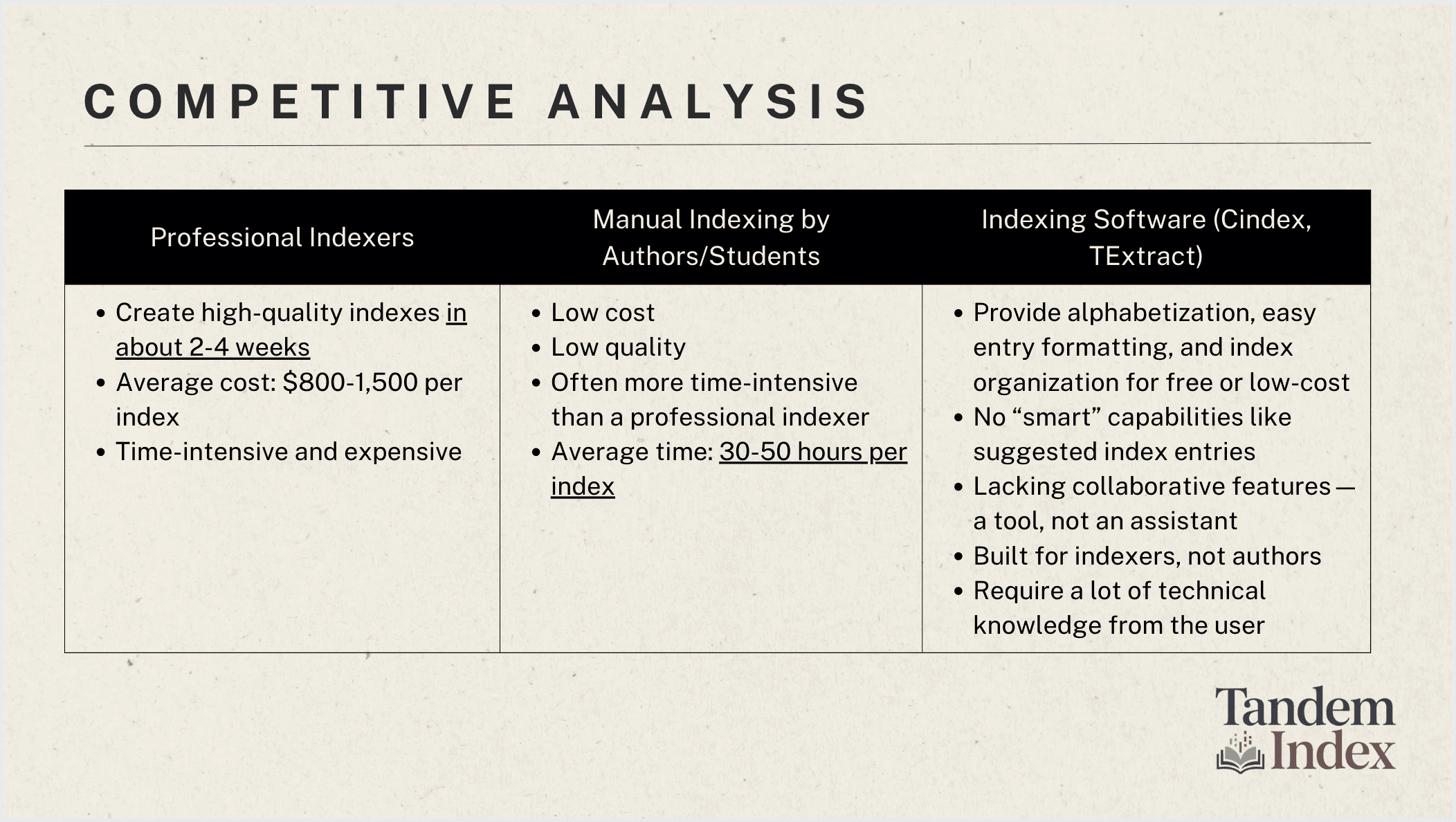
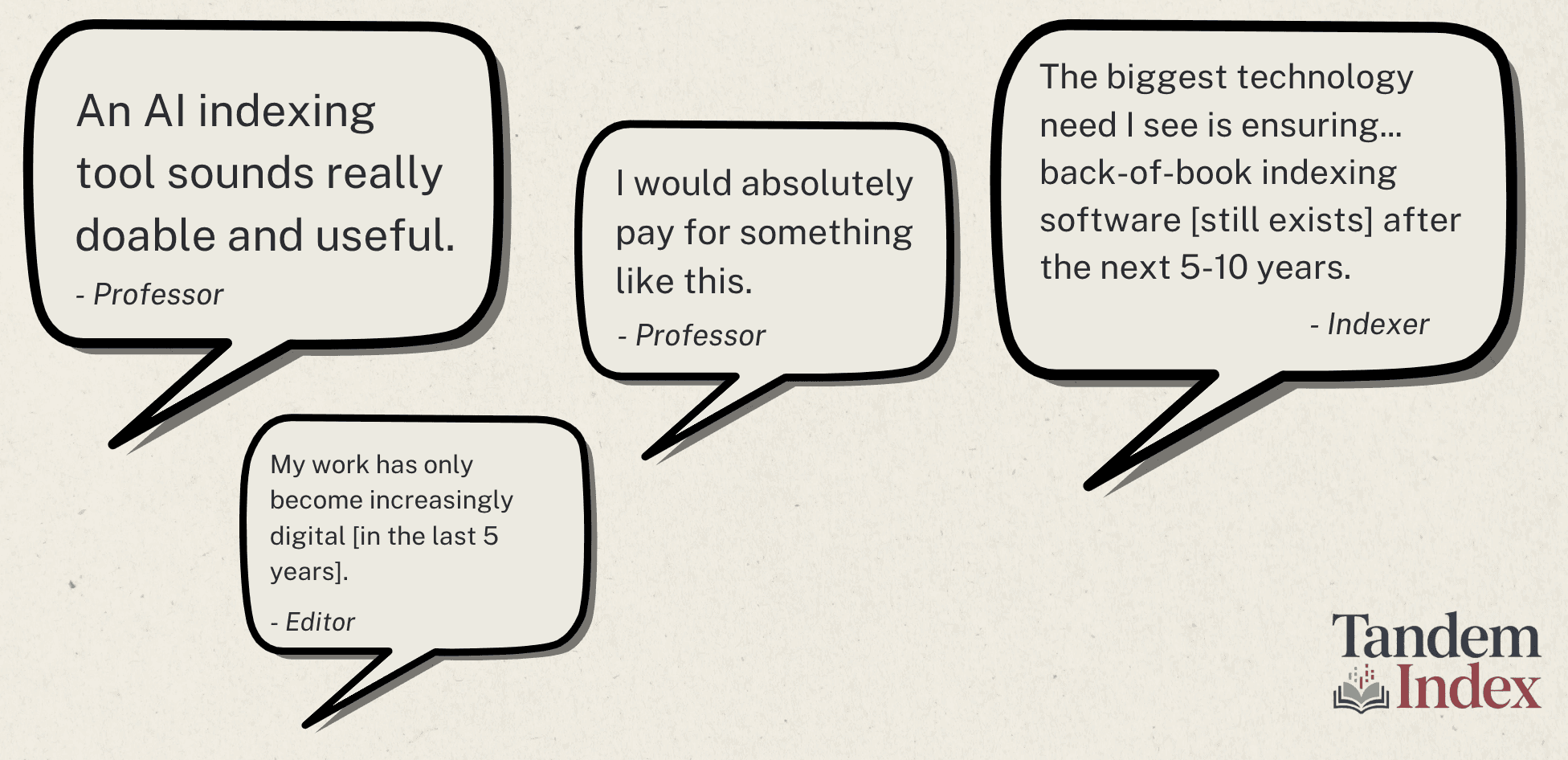
I also interviewed more than 20 target market members to understand their current processes and use of indexing software. I found that most indexing software is rapidly growing obsolete without developers committed to maintaining its feasibility. The time is ripe for a new indexing software to enter the market, one that is user-friendly and efficient.
Prototype
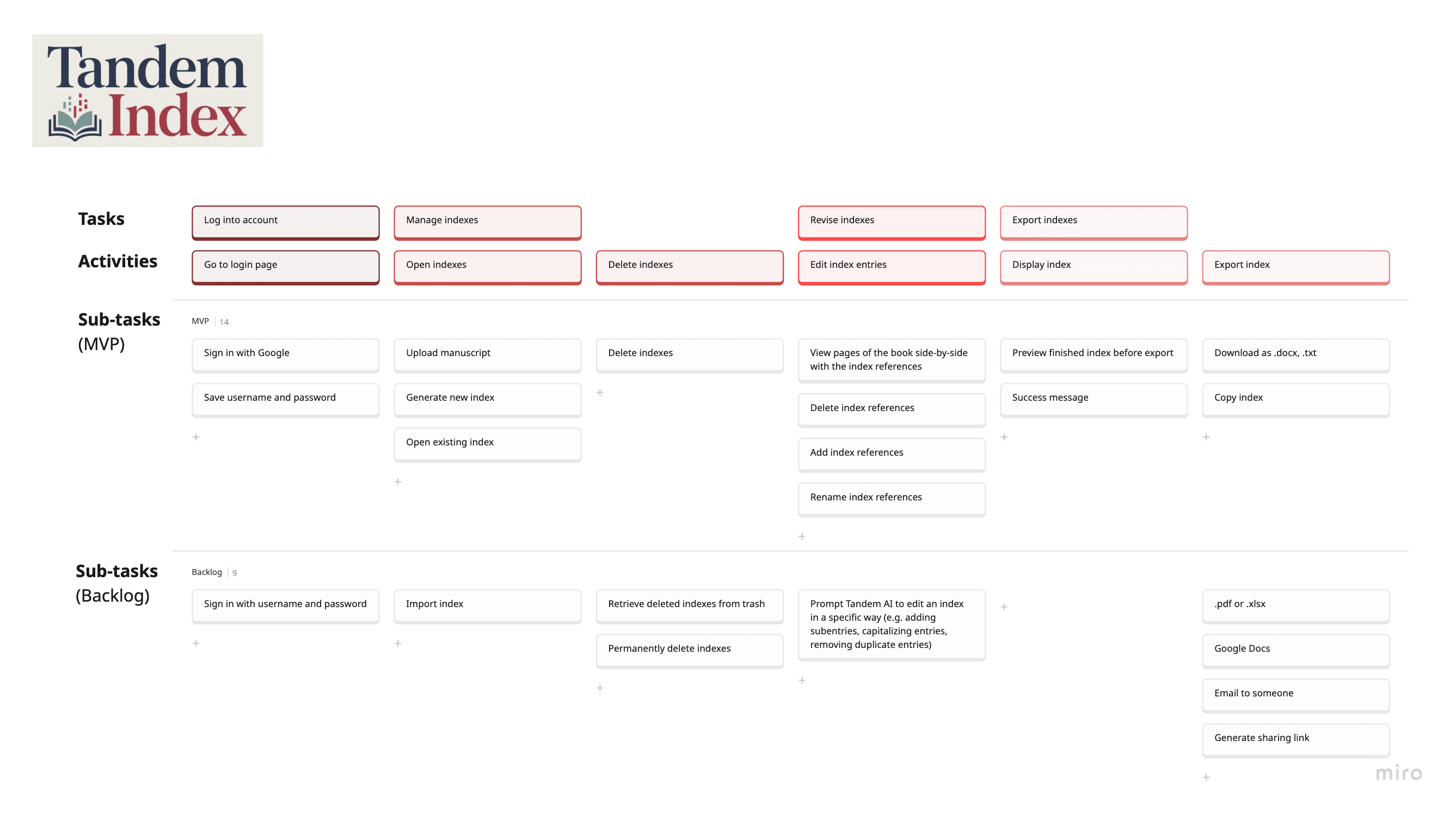
With my research insights distilled into possible features, I whiteboarded the tool in Miro with a storymap inspired by the Lean Startup methodology.
I also wrote a 13-page business plan to present to judges for a college pitch competition.
Next, I prototyped the initial product in a 5-week sprint before the pitch.
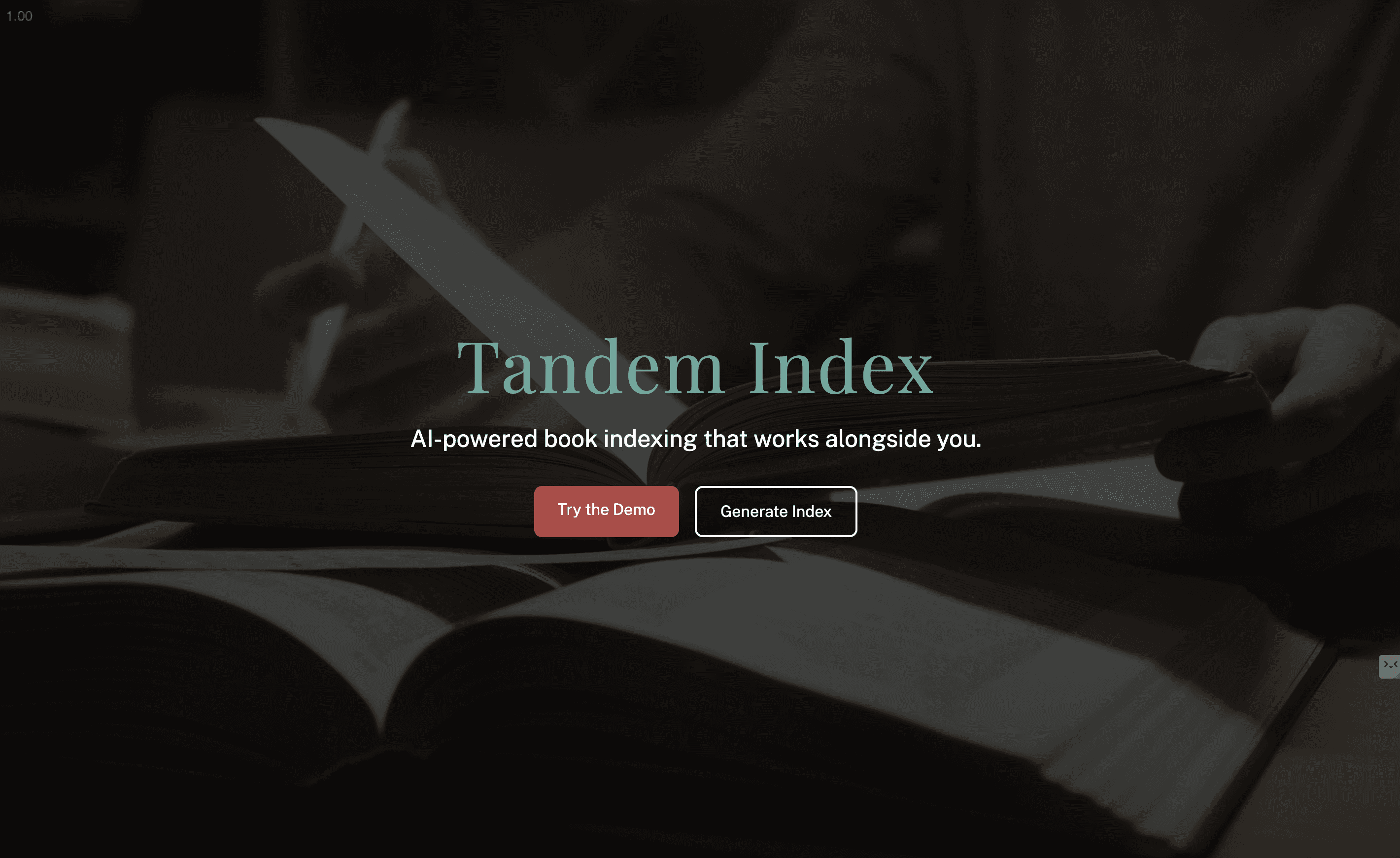
I thought critically about the index creation user flow, which includes necessary details and instructions, a progress tracker, and then a user-friendly display of the drafted index. I wanted this to feel as intuitive as possible.
You can see this process in action via the video demo below.
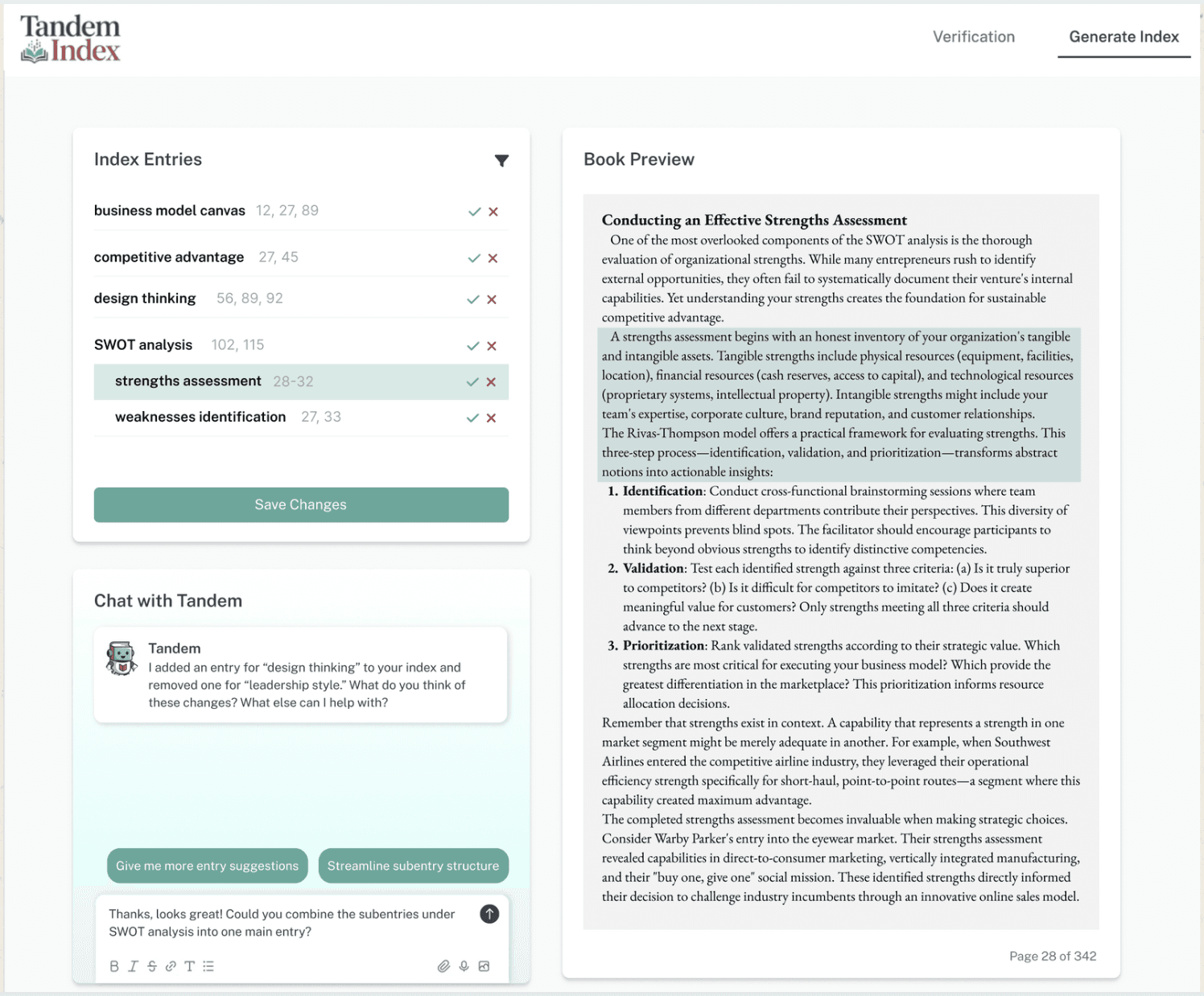
In addition, I prototyped this design for a side-by-side index editor in Figma.
Gather Feedback
I pitched to the judges and won first place. Below are some highlights from the 7-minute pitch.
Iterate and Launch
I'm launching a large-scale research project right now with the goal of interviewing 30+ authors and other stakeholders and launching an MVP before December.
I'm continuing to iterate on design and development, specifically focusing on developing enterprise-grade security practices for manuscript handling, like encrypted cloud storage with Google Cloud. I've hired an engineer to help accelerate development, and we've pivoted to focusing on security after talking more with publishers, whose biggest concern is data privacy.
95% of professors whom I've spoken with have mentioned that indexing is one of their major pain points in the publishing process.
You can view the current prototype here.